Why I Created Exlectio
I created Exlectio to help churches preserve the sermons they already work hard to create and make them useful long after Sunday.
I preach a sermon every week.
Like most pastors, a lot goes into those messages before anyone ever hears them on Sunday morning. There are hours of reading, studying, thinking, praying, writing, rewriting, and trying to figure out how to communicate something clearly.
Then Sunday comes. You preach the sermon. And then Monday comes.
For years, Monday usually meant that sermon manuscript went into a folder on my computer. I might come back to it someday. I might remember a story or illustration from it. I might even preach from the same passage again years later.
But for the most part, something I had invested hours creating had a useful life of about 35 minutes.
That started bothering me.
Not because I think every sermon I preach deserves to be immortalized. Trust me, I’ve preached enough to know better.
It bothered me because I started asking a different question:
What if the sermon didn’t have to stop being useful when Sunday ended?
That question eventually became Exlectio.
We Already Did the Hard Part
Churches create an enormous amount of teaching.
Think about what happens over the course of a year. A pastor may preach 40, 50, or more messages. Add Wednesday nights, other pastors and teachers, special services, conferences, and additional teaching environments, and a church can produce a substantial body of biblical teaching every year.
We already did the hard part.
We studied it. We prayed over it. We wrote it. We preached it.
But what happens to all of that material afterward?
For many of us, the answer is surprisingly simple: it goes into a folder.
Mine certainly did.
I had folders organized by sermon series, dates, books of the Bible, and whatever organizational system made sense to me at the time. The sermons were technically preserved, but they weren’t particularly useful.
There is a difference between storing something and being able to use it.
That difference is the problem I wanted Exlectio to solve.
From Sermon Folder to Sermon Library
Imagine someone in your church remembers that you preached about forgiveness a year and a half ago.
Can they find it?
What if a small-group leader wants to see what the church has taught through Romans? What if a future staff member wants to understand how your church has historically taught on marriage, generosity, discipleship, prayer, or the Holy Spirit?
Or maybe the problem is much simpler.
You vaguely remember an illustration you used three years ago, but you have absolutely no idea which sermon it was in.
Those are very different problems than simply asking, “Did I save the file?”
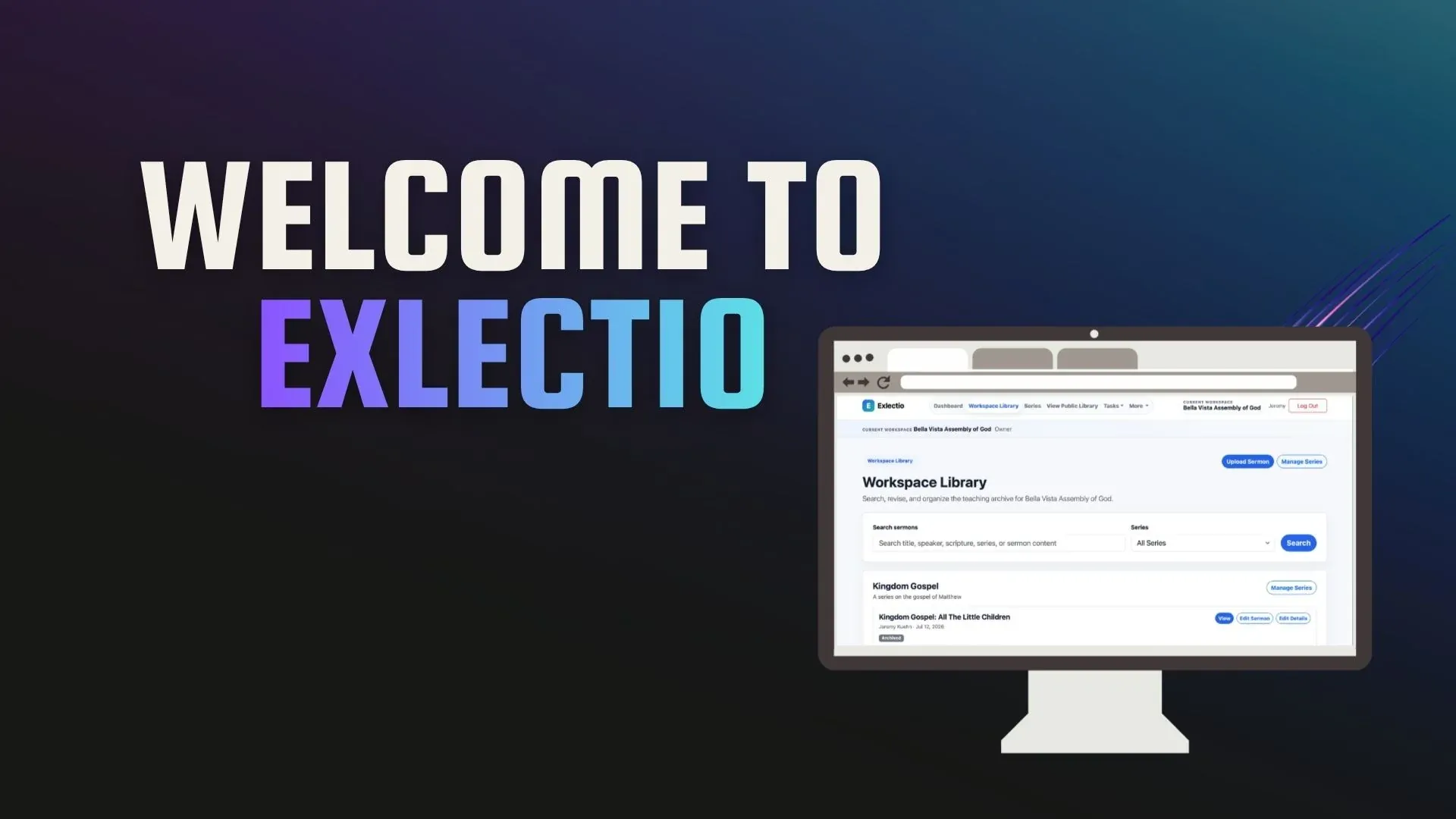
I wanted to be able to search the teaching our church had already created. That’s why one of the foundational ideas behind Exlectio is turning sermon manuscripts into a searchable library.
Sermons can be organized by Scripture, topic, series, speaker, tags, and keywords. Instead of accumulating files, the church begins building a body of teaching that becomes more valuable as the library grows.
Over five years, that’s significant.
Over ten years, even more so.
Preserve the Original, Improve the Working Copy
There was another problem I wanted to solve.
I wanted the convenience of having a clean, readable sermon in the library without sacrificing the manuscript I actually preached.
Those aren’t always the same thing.
If you’ve ever looked at a preaching manuscript after the sermon is over, you probably know exactly what I mean. A manuscript designed to help someone preach might contain shorthand, stage directions, incomplete sentences, reminders, illustrations written only well enough to jog the pastor’s memory, or formatting that makes perfect sense behind a pulpit but not six months later.
So Exlectio preserves the original PDF or DOCX file while also creating an editable working copy.
That distinction matters to me.
The original remains the original. The working copy can become something more useful.
And that’s where AI enters the picture.
Where I Think AI Actually Helps
I didn’t build Exlectio because I wanted AI to write sermons.
I built it because I saw places in the work surrounding a sermon where AI could save time without replacing pastoral judgment.
One of those places is cleaning up a preaching manuscript.
Exlectio can use AI to take the manuscript a pastor already created and produce a cleaner, more readable working draft. But I intentionally didn’t want that process to end with AI.
A person reviews the result, edits it, and decides what is actually approved.
That distinction is important.
I’m interested in AI as a tool. I’m much less interested in handing theological judgment over to it.
AI can help clean up formatting. It can help make a spoken manuscript easier to read. It can help organize information and reduce some of the repetitive work surrounding content a pastor has already created.
But the church should remain responsible for what the church publishes.
That’s why nothing in Exlectio automatically becomes public simply because AI touched it. There is a human review process and intentional publishing controls built into the workflow.
AI assists. People approve.
That’s the model I wanted for my own church, so that’s the model I built.
What Else Could the Sermon Do?
Once I started thinking about sermons this way, another question became obvious.
What else could we do with something we’ve already created?
Small groups were one of my first answers.
A church shouldn’t necessarily need to start from a blank page every week to create discussion material related to Sunday’s message. The sermon already contains the Scripture, central idea, theological framework, illustrations, and applications.
So Exlectio can use that sermon to help create an editable small-group discussion guide.
Again, the word editable matters.
The goal isn’t to have AI pastor the small group. The goal is to give the pastor or ministry leader a useful starting point that can be reviewed, adjusted, and then handed to leaders.
That means the work invested in preparing one sermon can continue serving the church during the week.
And that gets at the larger idea behind Exlectio:
Get more ministry value from work the church is already doing.
From My Computer to the Church
Eventually, I realized I didn’t just want a better private sermon archive.
I wanted our church to be able to use it.
Exlectio allows a church to choose sermons from its internal library and publish them into a public sermon library. That library can also be embedded directly into the church’s existing website.
The important word there is choose.
Not every note needs to be public. Not every draft should be public. And not everything we’ve ever preached necessarily needs to live on the Internet forever.
The church decides what gets shared.
But the things we do want to make available can become part of an organized resource for church members, visitors, small-group leaders, staff, and whoever comes after us.
That’s something I particularly like thinking about.
A sermon library isn’t only about preserving what happened last Sunday.
It can become part of the institutional memory of a church.
Imagine a new pastor or staff member arriving five years from now and being able to search the teaching history of the church. Imagine a small-group leader finding a sermon from three years ago that addresses exactly what their group is discussing. Imagine a church member studying a passage and discovering that their pastor taught through it two years earlier.
The sermon was already preached.
The work was already done.
Exlectio simply helps make that work useful again.
Building Something for the Way Churches Actually Work
I also knew this couldn’t just work for one pastor sitting at one computer.
Church ministry is collaborative.
An administrative assistant may upload something. A pastor may edit it. Another staff member may organize a series. Someone responsible for discipleship may work on a small-group guide.
Passing Word documents around by email isn’t a great system for that.
So Exlectio uses a shared church workspace where owners and editors can work together in the same sermon library. Sermons and small-group guides can also be exported as PDFs when something needs to be printed, emailed, or distributed outside the system.
None of these features are particularly valuable simply because they are technologically impressive.
They’re valuable if they remove friction from ministry.
That’s the test I keep coming back to as I build this.
You can see how Exlectio works if you want a closer look at the workflow and features.
The Bigger Idea
I’m a pastor who also happens to enjoy building things with technology.
Exlectio came out of those two worlds colliding.
I didn’t start with the question, “What can I build with AI?”
I started with a folder full of sermons.
Those files represented hundreds of hours of study, prayer, writing, and preaching. And yet most of them had essentially disappeared from the life of the church after the Sunday they were preached.
I don’t think they have to.
What if Sunday’s sermon helped guide a small group on Wednesday?
What if someone searching for help with grief discovered a sermon their pastor preached three years ago?
What if a new staff member could search years of teaching instead of digging through old folders?
What if the next generation of leaders inherited an organized library of what their church had taught?
That’s what I want Exlectio to help churches build.
Not more content for the sake of content. Not AI replacing pastors. Not another complicated piece of church software.
Just a practical way to take something churches are already investing deeply in every single week and make it useful for longer.
Sunday’s sermon shouldn’t have to end on Sunday.
That’s why I created Exlectio.