Pastoring on the Trail: What Mountain Biking and Trail Running Teach Me About Leadership, Faith & Life
Mountain biking and trail running in Northwest Arkansas give me room to focus, listen, and lead with the perspective I need as a pastor in Bella Vista.
I grew up in Northwest Arkansas and started mountain biking sometime in the early 2000s. Back then, my mountain biking world was basically Lake Fayetteville. I would ride around the lake, and compared to what exists today, there simply wasn’t much to choose from.
Then, sometime in the late 2000s and early 2010s, trails started showing up in Bentonville. More appeared in Fayetteville. Eventually Bella Vista joined in. Today, Northwest Arkansas has hundreds of miles of singletrack running through the Ozarks, and I’ve had the privilege of watching much of that transformation happen firsthand.
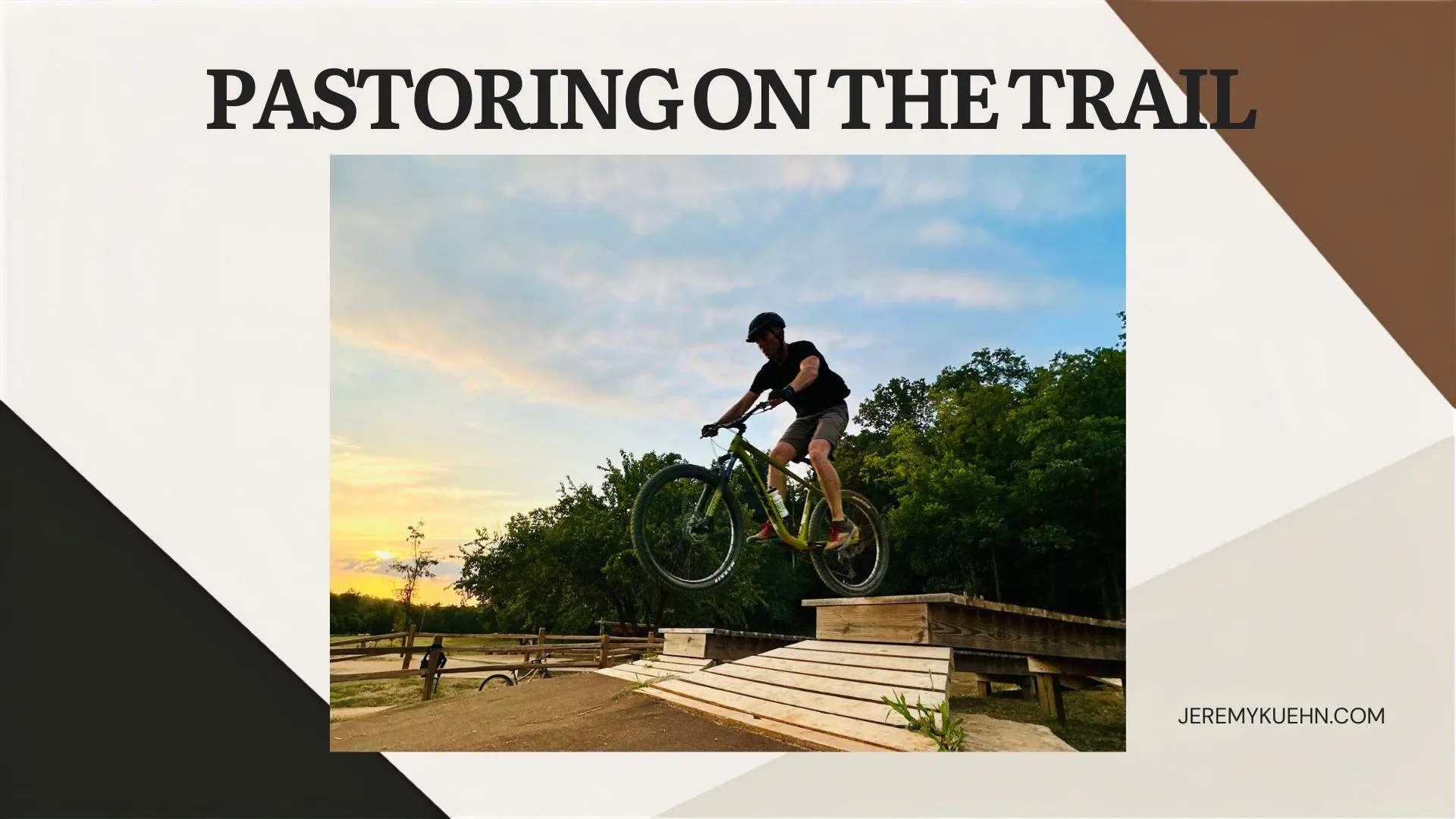
Along the way, mountain biking and trail running have become a consistent part of my life. On any given week, I try to make it onto a trail at least twice. Sometimes I run. Sometimes I ride. I’m not particularly interested in turning either one into some profound spiritual exercise. Most of the time, I just enjoy being outside.
But I’ve noticed that the trail does something for me that very few other places do.
It gives me room to focus.
I make a habit of not taking my phone. There are plenty of good reasons to carry one into the woods, so I’m not necessarily recommending my practice to everyone. But for me, leaving it behind has become part of the experience. My phone represents access: email, texts, news, social media, problems, questions, and all the little red notification bubbles reminding me there is something else I could be doing.
Pastoring is a particularly accessible vocation. There is almost always someone who can reach you and almost always something that could use your attention. That’s not a complaint. People matter, and being available is part of ministry. But I’ve also learned that being constantly accessible can make it difficult to be fully present anywhere.
The trail gives me a place where there is only one thing in front of me. Sometimes literally: a rock, a root, a switchback, or a climb I underestimated when I chose the route.
Making room for focus
There are basically two ways I use that space. Sometimes I turn up the pace enough that I don’t have the mental capacity to think about much of anything except what’s directly in front of me. On a mountain bike, I have to pick a line, watch the terrain, and commit. Running isn’t much different. Get moving fast enough on a technical trail and your brain becomes wonderfully uninterested in next Sunday’s sermon.
Other times, I deliberately slow down.
Those are the days when the trail becomes a place to think. I’ve worked through sermons while running. I’ve thought through leadership problems. I’ve prayed. I’ve developed ideas. I’ve reconsidered things that seemed incredibly important when I was sitting in my office. There is something about moving through the woods that gives my mind room to wander without feeling distracted.
The only problem is that some of my best ideas seem to occur when I’m several miles away from anything I can use to record them. I’ve probably lost more than a few good sermon illustrations somewhere in the Ozarks.
For a long time, I thought the value of that time was what it produced. If I came home with an idea, some clarity, or a sermon thought, then it had been productive. I’m increasingly less convinced that’s the point.
Leaders have a tendency to turn everything into output. If we’re driving, we can make a phone call. If we’re exercising, we can listen to a podcast. If we’re sitting quietly, we should probably be reading something that will make us better. Even rest can become another strategy for improving performance.
The trail resists that impulse, at least for me.
Sometimes thinking can just be thinking. Sometimes running can just be running. Sometimes riding a bicycle through the woods can just be riding a bicycle through the woods.
Strangely enough, I often come back a better pastor because of it.
Learning the terrain
There is probably something here about pace too. Leadership, like a trail, doesn’t happen at one speed. There are moments when you need to move quickly. You have the information you need, the decision needs to be made, and continuing to hesitate isn’t going to make the decision any better. Pick a line and go.
There are other moments when speed is exactly the wrong instinct. Slow down. Look ahead. Think. Pray. Listen. Give an idea enough room to become something more than your first reaction.
Mountain biking makes the difference painfully obvious. There are sections of trail where carrying a little speed actually makes the obstacle easier. There are others where charging ahead without looking at what’s coming is a great way to go over the handlebars.
Pastoring isn’t all that different.
Wisdom isn’t always moving slowly. Wisdom is learning which kind of terrain you’re on.
Two trails that have shaped me
Of all the places I’ve ridden and run in Northwest Arkansas, two trail systems have become particularly important to me.
The first is Kessler Mountain in south Fayetteville. Kessler has been a constant in my life for more than a decade. I’ve ridden there, run there, raced there, and spent a lot of Friday mornings there enjoying everything the Ozarks have to offer.
Kessler feels like the Ozarks. It’s rocky and technical, and there are places where the mountain seems almost personally offended that you’re trying to run up it. There are also remnants of the people who occupied the mountain long before people like me started riding expensive bicycles around it for recreation. Hidden in the woods are a few abandoned homesteads that can still be explored.
Since 2017, with only a few years missed, I’ve also run a winter race at Kessler called Frozen Toes. Running a trail race in the middle of winter sounds like a questionable decision, and occasionally it is. But it’s become one of those rhythms in my life that I look forward to.
What I like most about Kessler, though, probably has less to do with the quality of the trails and more to do with time. I’ve been going there long enough that I have history there. The landscape remains mostly familiar while the person moving through it changes. I’ve been on that mountain during different jobs, different seasons of ministry, different stages of raising a family, and now as a lead pastor.
Kessler hasn’t changed nearly as much as I have.
The other trail system is the Back 40 in Bella Vista. This one is different because it’s now in my backyard. The Back 40 winds through the ridges, hollows, bluffs, creeks, and neighborhoods of the community where I pastor. There are so many combinations of trails that I can go back repeatedly without every ride feeling exactly the same.
Living and pastoring in Bella Vista has also changed the way I experience those trails. I don’t only know this community from driving its roads, sitting in meetings, or pastoring a church here. I know parts of it one rock, hollow, climb, and switchback at a time.
That’s one of the things I love about Northwest Arkansas. The outdoors aren’t somewhere you have to travel to experience. They’re woven into life here. The same region where I get to pastor is also the place where I can leave my house and disappear into the woods for a couple of hours.
A family ethic, not a sermon illustration
Recently, that part of my life has gotten even better because my boys are getting old enough to ride with me.
For years, getting outside was primarily something I did for myself. Now it’s increasingly something we do together. At this point, being outside has become something of a family ethic for us. I want my kids to be comfortable getting dirty, exploring, riding bikes, running around, and experiencing the place where they live instead of only seeing it through a windshield or a screen.
Riding with them has also changed familiar trails for me. I may know what’s around the next corner. They don’t. Watching them experience something for the first time has a way of making it new for me again.
There is almost certainly a leadership lesson I could pull out of that.
But I don’t want to.
One of the things the trail is teaching me is that not everything needs to become material.
A bike ride with my boys doesn’t have to become a sermon illustration. A run doesn’t have to produce a leadership insight. Two hours in the woods don’t have to justify themselves by making me more effective when I get back to the office.
That’s probably part of what makes those things valuable.
Pastoring is more than a job. It’s a calling that touches almost every part of my life, and I genuinely love what I get to do. But I’ve also come to believe that pastors need places where they aren’t only pastors. We need interests that aren’t ministry strategies, relationships that aren’t networking opportunities, and time that isn’t measured entirely by what we produce.
For me, one of those places is the trail.
Sometimes I come back with a sermon idea. Sometimes I come back with clarity about a leadership decision. Sometimes I come back muddy, exhausted, and without having thought about church for two hours.
All three can be good outcomes.
I’ve lived in Northwest Arkansas for most of my life. I’ve watched the trail systems grow from the handful of places I knew as a young rider into something people now travel here to experience. Now I get to pastor in the middle of it.
I didn’t set out to connect those two parts of my life. I don’t think mountain biking is secretly a metaphor for ministry, and I don’t think trail running makes someone a better pastor.
I just know that leadership requires perspective. Faith requires space to listen. Life requires interests that don’t have to accomplish anything.
For me, the trail has become a place for all three.